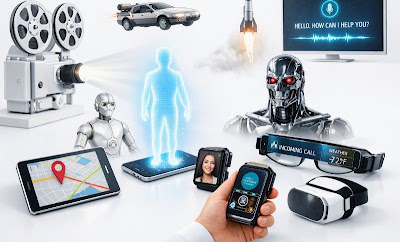
10 Technologies Predicted by Movies That Actually Exist Today

For decades, filmmakers have looked at the horizon of science and let their imaginations run wild. Eerily, what once seemed like sheer fantasy on the silver screen has seamlessly integrated into our ordinary routines. From classic black-and-white silent features to blockbuster hits of the late twentieth century, cinema has reliably mapped the future of human innovation. Instead of just entertaining audiences, these films acted as blueprints for the modern world. To see just how accurate these cinematic prophets really were, let us dive into ten incredible everyday technologies that filmmakers successfully predicted long before engineers built them.
1. Video Calling
The Movie: Metropolis (1927)
The Reality: Platforms like Zoom and FaceTime.
The Reality: Platforms like Zoom and FaceTime.
How it matched: Decades before the internet or smartphones existed, Fritz Lang’s silent masterpiece featured a wall-mounted “Phonofilm” that allowed characters to chat via a live video screen while speaking on a telephone. It perfectly set the template for the video conferencing tools we use for work and family check-ins today.
2. Tablet Computers
The Movie: 2001: A Space Odyssey (1968)
The Reality: The Apple iPad and modern touchscreen slates.
The Reality: The Apple iPad and modern touchscreen slates.
How it matched: Stanley Kubrick’s sci-fi epic showed astronauts eating breakfast while reading news on flat, thin electronic screens called “Newspads”. The sleek, buttonless design and layout are virtually indistinguishable from the modern tablets sitting on our coffee tables.
3. Voice-Activated AI Assistants
The Movie: 2001: A Space Odyssey (1968)
The Reality: Amazon Alexa, Apple Siri, and conversational AI.
The Reality: Amazon Alexa, Apple Siri, and conversational AI.
How it matched: The film’s antagonist, the HAL 9000 computer, could interpret natural language, speak in a calm synthesized tone, and control the ship’s internal mechanics. Aside from the homicidal tendencies, HAL laid the exact foundation for how we use voice commands to dim our smart lights or ask about the morning weather forecast.
4. Smartwatches and Wearables
The Movie: Back to the Future Part II (1989)
The Reality: The Samsung Galaxy Watch and other modern smartwatches.
The Reality: The Samsung Galaxy Watch and other modern smartwatches.
How it matched: Cinema has long been obsessed with putting communication on our wrists. Whether it was characters receiving calls on their personal apparel or talking directly into their wrists, movies accurately foresaw a world where we look at our arms to check notifications, text friends, and answer phone calls.
5. Self-Driving Cars
The Movie: Total Recall (1990)
The Reality: Autonomous vehicles and self-navigating taxi services.
The Reality: Autonomous vehicles and self-navigating taxi services.
How it matched: When Arnold Schwarzenegger escapes in a “Johnny Cab,” he steps into a vehicle entirely operated by an onboard computer autopilot system. While today’s real-world autonomous vehicles don’t feature a creepy robotic mannequin chauffeur, the underlying radar, GPS, and steering automation match the movie’s vision.
6. Hyper-Targeted, Personalized Advertising
The Movie: Minority Report (2002)
The Reality: Targeted social media ads and browser tracking cookies.
The Reality: Targeted social media ads and browser tracking cookies.
How it matched: In this futuristic thriller, digital billboards scan the protagonist’s retinas as he walks through a shopping center, shouting out customized product recommendations tailored exactly to his shopping history and calling him by his name. This maps directly onto how internet companies analyze our browsing habits to serve personalized ads today.
7. Biometric Security
The Movie: Blade Runner (1982)
The Reality: Facial recognition systems and fingerprint scanners like Face ID.
The Reality: Facial recognition systems and fingerprint scanners like Face ID.
How it matched: Ridley Scott’s dystopian masterpiece famously illustrated retinal imaging scanners and voice analysis checkpoints used to verify a person’s biological identity before granting access to buildings. Today, this biological security is so mundane that billions of consumers use their faces and fingerprints to unlock their smartphones and log into banking apps every single morning.
8. Robot Vacuums
The Movie: The Jetsons (1962 TV Series / 1990 Movie)
The Reality: The iRobot Roomba and smart vacuum cleaners.
The Reality: The iRobot Roomba and smart vacuum cleaners.
How it matched: While The Jetsons was an animated production rather than a live-action film, its vision of home automation was incredibly accurate. The show featured a small, disc-shaped robotic vacuum cleaner that scurried across the floor to pick up dust entirely on its own. Today, millions of automated circular vacuums navigate our living room rugs using almost the exact same form factor.
9. Gesture-Controlled Computing
The Movie: Minority Report (2002)
The Reality: Spatial computing and headsets like the Apple Vision Pro.
The Reality: Spatial computing and headsets like the Apple Vision Pro.
How it matched: One of the most iconic scenes in modern sci-fi shows a detective waving his hands in mid-air to swipe, zoom, and organize files on a transparent digital interface without ever touching a keyboard or mouse. This exact motion tracking is now a cornerstone of modern virtual reality and spatial computing interfaces.
10. Military Drones
The Movie: The Terminator (1984)
The Reality: Unmanned Aerial Vehicles (UAVs) used for global defense and surveillance.
The Reality: Unmanned Aerial Vehicles (UAVs) used for global defense and surveillance.
How it matched: Long before remote-controlled military aircraft were standard hardware in international defense frameworks, early sci-fi portrayed automated, flying hunter-killer ships patrolling the skies without any human pilots on board. Today, surveillance and tactical drones mimic these cinematic machines with haunting operational accuracy.
Looking back at these classic films reminds us that yesterday’s science fiction is almost always tomorrow’s reality. Filmmakers and writers have an uncanny ability to identify human desires—the need for seamless communication, automated help, and tighter security—and project how technology might one day solve them. As we continue to build increasingly advanced tech, it makes you wonder which of today’s blockbuster sci-fi films are actually giving us a sneak peek into the next few decades of our lives.